Ohrid: City of a Thousand Churches
Ohrid: City of a Thousand Churches (https://main--masterclass-demo--znikolovski.aem.live/blog/ohrid-city-of-thousand-churches)
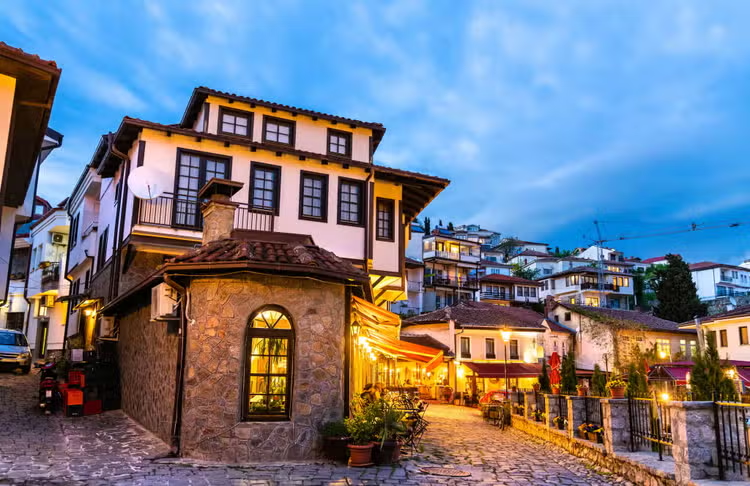
Perched on the shores of one of Europe's oldest and deepest lakes, Ohrid is a city that wears its history like a crown. With over 365 churches — one for every day of the year, locals proudly say — cobblestone streets that climb toward a medieval fortress, and water so clear it shimmers turquoise in the afternoon sun, this small city in southwestern North Macedonia is one of the Balkans' most extraordinary destinations. It is a UNESCO World Heritage Site for both its natural and cultural values, and it earns that designation completely.
I arrived on a Thursday evening in late May, stepping off a bus from Skopje into warm air that smelled of lake water and grilling fish. Within ten minutes of walking into the old town, I had already stopped three times to take photographs. Ohrid does that to you immediately.
A City Born Before History Was Written
Ohrid's story stretches back more than 2,500 years. Known in antiquity as Lychnidos — meaning "city of light" — it was a prosperous settlement along the Via Egnatia, the great Roman road that connected the Adriatic to the Aegean. Coins, mosaics, and the remains of a Roman-era amphitheatre still surface across the hillsides, reminders that Ohrid has been a crossroads of civilisations for millennia. The theatre, which sat around 5,000 spectators, is still used today for summer concerts and performances — one of the few ancient venues in the Balkans that has retained a living cultural function.
In the 9th century, Saints Clement and Naum, disciples of the Byzantine missionaries Cyril and Methodius, chose Ohrid as the base for their Slavic literary mission. Clement established a school here that is considered one of the first universities in Europe. More than 3,500 students were trained here in the Glagolitic and early Cyrillic alphabets, which were then spread across the entire Slavic world. For this reason alone, Ohrid holds a singular place in the cultural heritage of hundreds of millions of people — a fact the city wears with understated pride.
Ohrid's old town climbs steeply from the lakefront through a maze of Ottoman-era timber houses toward Samuil's Fortress at the summit.
Three Hundred and Sixty-Five Churches
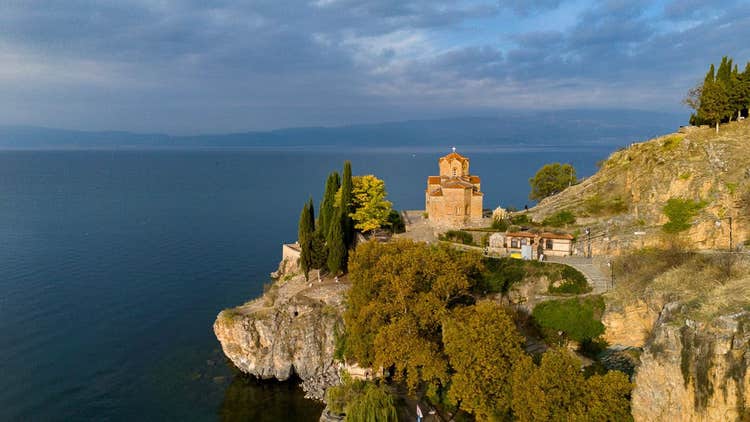
No monument defines Ohrid more than its churches. The city and the surrounding region contain dozens of surviving Byzantine and medieval Orthodox churches, with frescoes that rival those of Constantinople. The most photographed is the Church of Saint John the Theologian at Kaneo, a 13th-century chapel balanced on a rocky promontory directly above the lake. It is, without exaggeration, one of the most beautifully positioned buildings in Europe. At sunset, when the limestone walls glow amber and the water below turns deep violet, it produces the kind of scene that makes you put the camera down and simply look.
The Church of Saint Sophia, a large 11th-century cathedral in the lower town, is equally unmissable. Its interior walls are covered in remarkably preserved Byzantine frescoes — images of apostles, angels, and donors rendered in deep reds and blues that have survived nearly a thousand years. The building was converted to a mosque under Ottoman rule and then reconverted after independence; layers of whitewash were carefully removed in the 20th century to reveal the frescoes underneath, an archaeological act of extraordinary patience.
The Church of Saint John at Kaneo, built in the 13th century on a rocky cliff above Lake Ohrid — the most photographed spot in North Macedonia.
High above the old town, the Monastery of Saints Clement and Panteleimon stands within the remains of Samuil's Fortress, the 10th-century stronghold of Tsar Samuil of the First Bulgarian Empire. The walls of the fortress wrap around the entire hilltop and offer a sweeping panoramic view across the full basin of Lake Ohrid, extending south into Albania. Standing on those walls at dusk, watching the last light fade over the water, it is easy to understand why every empire that swept through the Balkans fought to control this city.
Lake Ohrid: A Living Fossil
Lake Ohrid is no ordinary body of water. Estimated to be between 3 and 5 million years old, it is one of the oldest lakes in the world and a site of exceptional biological diversity. More than 200 endemic species — plants, fish, snails, and invertebrates found nowhere else on Earth — inhabit its depths. The lake reaches 288 metres at its deepest point and its water is so exceptionally pure that visibility can exceed 20 metres. It is classified as an ancient lake alongside Baikal and Tanganyika, a category that fewer than twenty lakes in the world qualify for.
The Ohrid trout (Salmo letnica), a large silvery fish endemic to these waters, appears on restaurant menus across the city, typically grilled whole with lemon and local herbs. Swimming in the lake from the rocky beaches near the old town is a summer institution — the water is cool even in July and startlingly clear. Looking down from the surface you can see your feet against the stones three metres below.
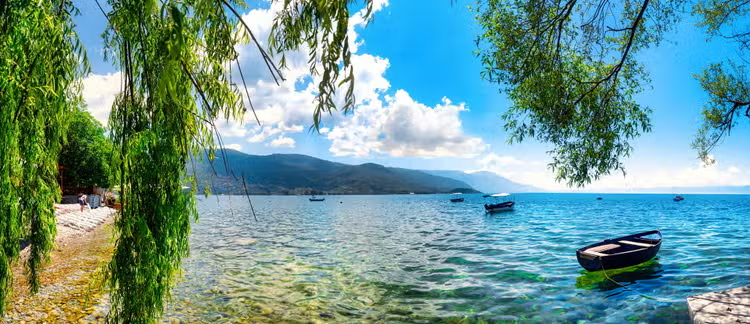
Lake Ohrid from above — one of the world's oldest lakes, shared between North Macedonia and Albania, with over 200 endemic species.
A boat trip south along the shore leads to the Monastery of Saint Naum, 30 km from Ohrid and set in a forest of peacocks and spring-fed pools at the Albanian border. The springs here — where underground rivers from deep in the mountains emerge into the lake through the lake floor — are visible as shimmering columns of cold water rising through the warm surface layer. It is one of the stranger and more beautiful natural phenomena I have witnessed anywhere.
The Old Town on Foot
Ohrid's old town is compact and almost entirely pedestrianised. The main street, Sveti Kliment Ohridski, runs along the waterfront past café terraces and souvenir stalls selling traditional Ohrid pearls — a local craft product made from fish scales that has been produced here for over a century. From the waterfront, a series of steep lanes climb through neighbourhoods of timber-framed Ottoman houses with overhanging upper storeys, past small churches with open courtyards, to the fortress walls at the top.
The evening promenade along the waterfront is a genuine local institution. At dusk, the entire population of the old town appears to be outside, walking, eating ice cream, stopping to talk. Restaurant terraces fill up. Music starts somewhere. The lake turns pink. It is a remarkably pleasant place to simply exist in.
What to Pack and Plan
- Best time to visit: Late May through September for warm weather and lake swimming. July and August bring the Ohrid Summer Festival — classical music, theatre, and opera in ancient venues.
- Getting there: Ohrid Airport (OHD) has direct seasonal flights from several European cities including London, Zurich, and Amsterdam. Skopje Airport is 3 hours by road through mountain scenery.
- Footwear: The old town is steep cobblestone throughout. Grip-soled shoes are essential — sandals are fine on the waterfront but will frustrate you above it.
- Sun protection: The lake amplifies UV reflection significantly. Sunscreen SPF 50+, polarised sunglasses, and a hat are non-negotiable in summer.
- Currency: North Macedonia uses the Macedonian denar (MKD). ATMs are available in town but cash is strongly preferred at smaller restaurants, churches, and craft stalls.
- What to eat: Grilled Ohrid trout, tavče gravče (baked beans slow-cooked in a clay pot), ajvar (roasted red pepper relish), and pastrmajlija flatbread. Wash it down with wine from the Tikveš region — the local Vranec grape makes a very good red.
- Saint Naum day trip: Either hire a water taxi from the harbour (40 min by boat, beautiful) or drive the 30 km lakeside road. Go early — the monastery grounds fill up by midday in summer.
- Church etiquette: Most churches charge a small entrance fee (1–2 EUR). Shoulders and knees must be covered; scarves are usually available just inside the door.
- Accommodation: The old town has a good range of family-run guesthouses and small hotels in traditional houses. Book ahead for July and August.
Fast Facts: Ohrid
- UNESCO World Heritage Site since 1979 (cultural) and 1980 (natural)
- Population: approx. 42,000
- Altitude: 695 m above sea level
- Lake depth: 288 m (maximum)
- Lake age: 3–5 million years
- Endemic species in the lake: 200+
"Ohrid is one of those rare places where the weight of history does not feel like a burden — it feels like the ground you are standing on."
— Elena Markova
In the Field
Field Notes
More Stories
Essay
Mountain Photography
The camera as creative tool and physical burden. Alex R.'s landmark essay on shooting in high places.
Gear Guide
Ultralight Backpacking
What to cut, what to keep, and what the ultralight obsession reveals about how we think about wilderness.
Desert
Desert Survival Guide
From Taylor B., after three weeks in the Sonoran: the real lessons from moving through extreme heat.